
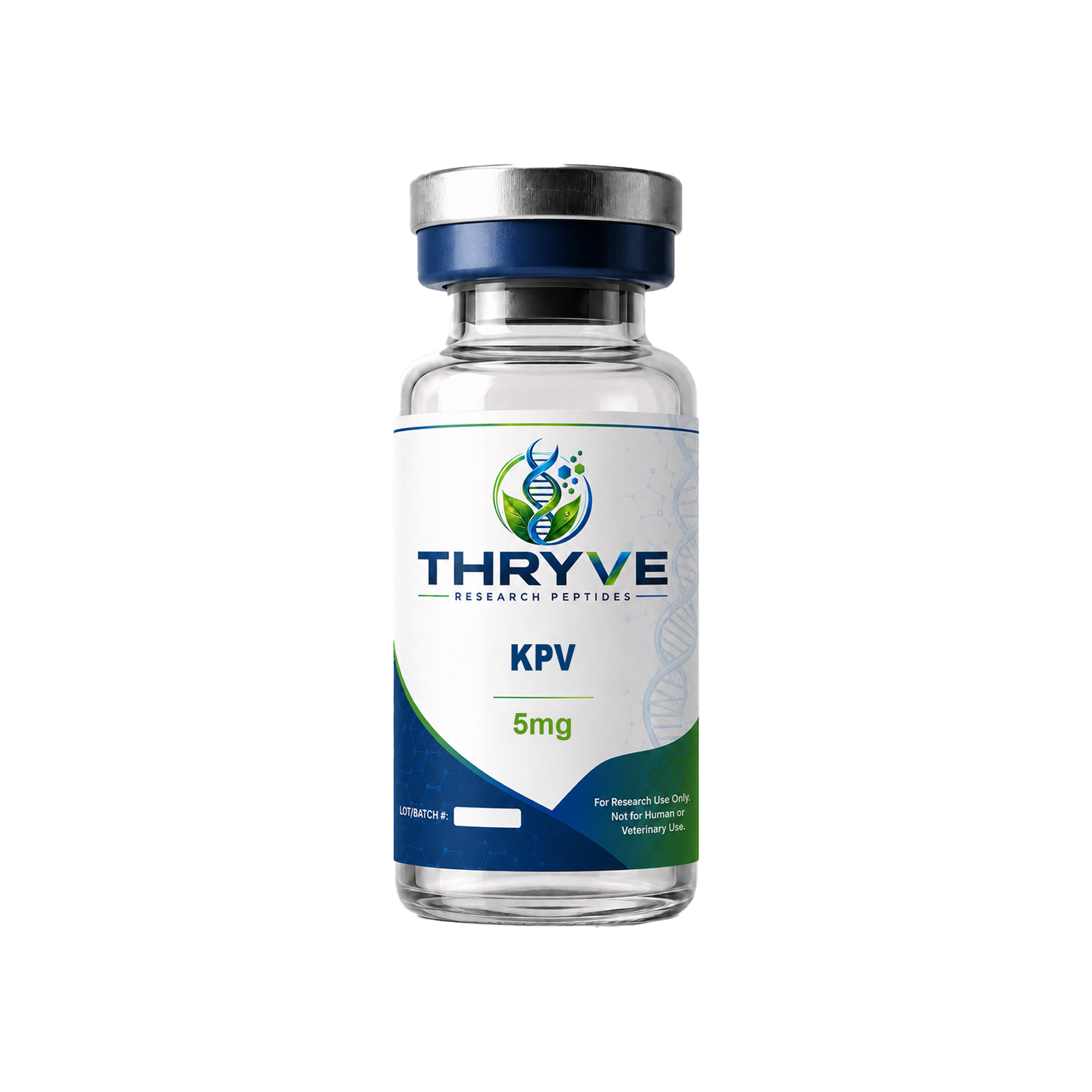
Description
PRODUCT OVERVIEW
A Three-Amino-Acid Peptide for Laboratory Research
KPV is notable for its small molecular structure and its relationship to α-MSH. Unlike the full-length parent peptide, KPV consists of only three amino acid residues.
Experimental studies have investigated KPV in relation to nuclear factor kappa B (NF-κB) signaling and the regulation of inflammatory mediators in cell-based and animal models. Although these findings have generated scientific interest, its precise molecular targets and mechanisms remain incompletely understood, and preclinical results do not establish clinical effectiveness in humans.
PRODUCT SPECIFICATIONS
| Specification | Details |
| Product Name | KPV |
| Scientific Name | Lysyl-Prolyl-Valine |
| Alternative Name | α-MSH (11–13) |
| Compound Classification | Synthetic tripeptide |
| Amino Acid Sequence | Lys-Pro-Val (KPV) |
| Peptide Length | 3 amino acids |
| Price | $89.00–$95.00 |
| Chemical Form | Refer to applicable product specifications |
| Purity | Refer to applicable product and lot documentation |
| Batch Identification | Where provided |
| Supporting Documentation | Applicable product or lot documentation |
SCIENTIFIC BACKGROUND
KPV represents the final three amino acids of α-MSH. Research into this peptide fragment has focused on whether selected biological activities observed with the parent peptide can also be investigated using the shorter sequence.
Preclinical studies have examined KPV in experimental models involving inflammatory signaling and cellular responses. Some findings suggest interactions with NF-κB-associated pathways, although its precise molecular targets have not been conclusively established.
The available evidence is primarily based on laboratory and animal research. These findings provide context for continued investigation but do not demonstrate established therapeutic benefits or confirm the biological activity of a specific commercial product.
RESEARCH APPLICATIONS
KPV may be examined in controlled laboratory settings for:
· Peptide Characterization: Evaluation of the reported Lys-Pro-Val sequence and molecular identity.
· Cellular Signaling Research: Investigation of pathways associated with NF-κB and related cellular responses.
· Inflammatory Pathway Studies: Examination of experimental findings involving inflammatory mediators in defined research models.
· Peptide Structure Analysis: Assessment of the molecular characteristics of a short tripeptide.
· Analytical Testing: Evaluation of compound identity, composition, and reported purity using appropriate laboratory methods.
· Comparative Research: Examination of structural differences between KPV and the parent α-MSH peptide.
These applications describe scientific research areas and do not establish clinical efficacy or product-specific biological effects.
QUALITY & LABORATORY DOCUMENTATION
Products are supported by applicable third-party laboratory testing documentation. Independent verification and additional testing may be conducted where appropriate.
Researchers should review the applicable documentation for reported identity, purity, analytical methods, testing dates, laboratory information, and batch identification, where available. Documentation should correspond to the specific product and lot being evaluated.
LOT & BATCH REFERENCE
Where a lot number or batch identifier is provided, retain it alongside the corresponding laboratory documentation. This supports traceability and helps researchers associate analytical findings with the relevant peptide material.
STORAGE & HANDLING
Store and handle KPV according to the supplier-provided specifications and applicable laboratory procedures. Refer to the product-specific documentation for storage conditions, packaging requirements, and handling precautions.
RESEARCH USE STATEMENT
KPV is offered strictly for laboratory and scientific research purposes. It is not intended for human or veterinary use, consumption, diagnosis, treatment, or prevention of any disease.
IMPORTANT NOTICE
Research involving KPV remains primarily preclinical, and its precise molecular targets are not fully established. Review the applicable product specifications and supporting laboratory documentation before research use. No claim is made that this product is approved for human use or has established clinical benefits.
Reviews
There are no reviews yet.