
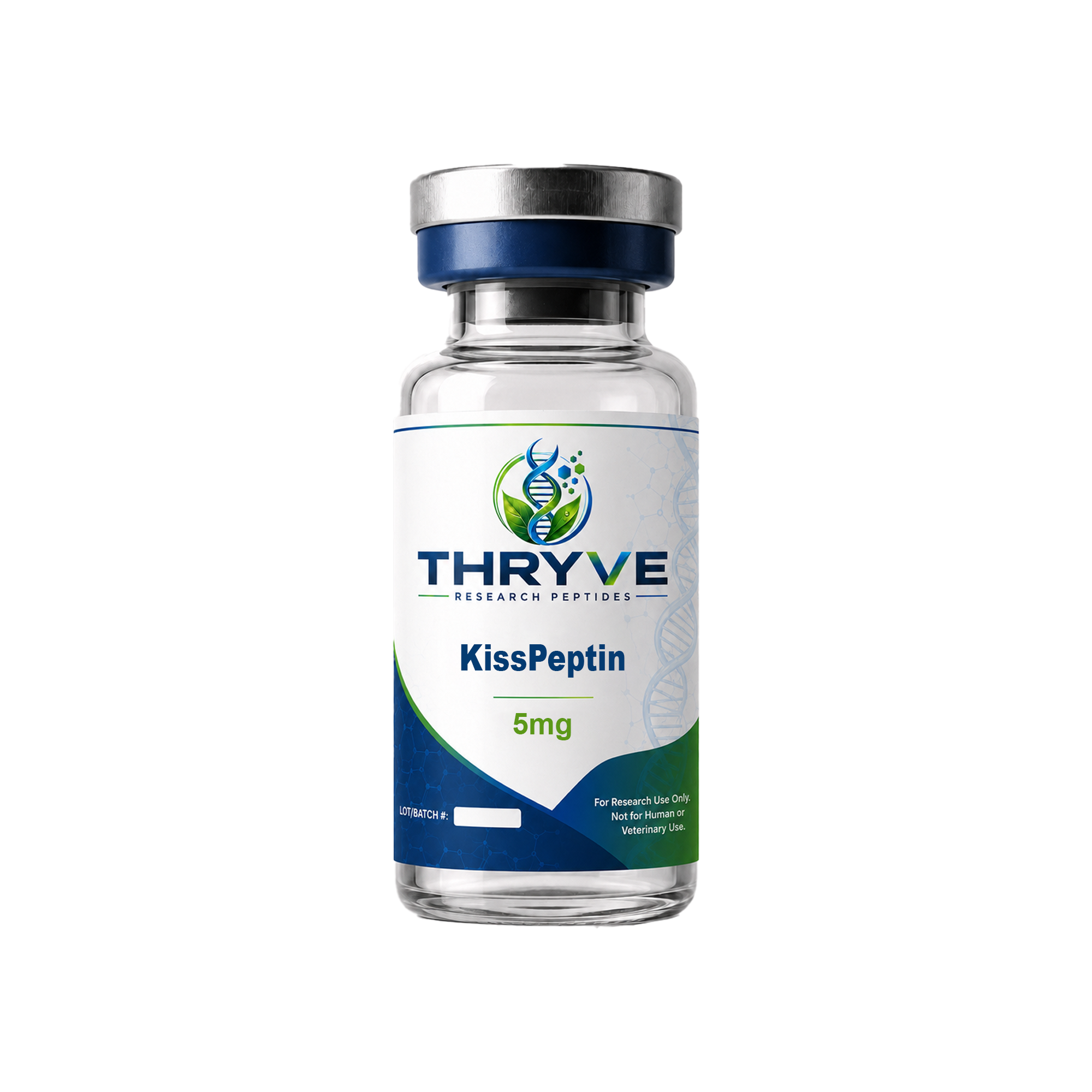
Description
PRODUCT OVERVIEW
A Peptide for Receptor and Neuroendocrine Research
Kisspeptin occurs in several molecular forms, including kisspeptin-54 (KP-54), kisspeptin-14, kisspeptin-13, and kisspeptin-10. These forms share a common C-terminal sequence associated with activation of KISS1R, although their molecular lengths and properties differ.
Research has examined how kisspeptin signaling influences GnRH secretion and downstream signaling involving luteinizing hormone (LH) and follicle-stimulating hormone (FSH). These pathways make kisspeptin relevant to laboratory investigations of neuroendocrine regulation and receptor activity.
Because the term Kisspeptin can refer to different peptide forms, the exact isoform and molecular sequence should be confirmed through the supplier’s specifications and applicable laboratory documentation.
PRODUCT SPECIFICATIONS
| Specification | Details |
| Product Name | Kisspeptin |
| Scientific Classification | Neuropeptide |
| Gene Association | KISS1 |
| Primary Research Receptor | KISS1R |
| Research Category | Neuroendocrine signaling |
| Peptide Form | Confirm the specific isoform with the supplier |
| Price | $89.00–$99.00 |
| Purity | Refer to applicable product and lot documentation |
| Batch Identification | Where provided |
| Supporting Documentation | Applicable product or lot documentation |
SCIENTIFIC BACKGROUND
Kisspeptin is recognized as an important upstream regulator of GnRH secretion. By interacting with KISS1R, it participates in signaling processes that influence the release of reproductive hormones and the coordination of the HPG axis.
Scientific studies have explored kisspeptin’s role in reproductive development, hormone regulation, and the integration of metabolic and environmental signals with neuroendocrine activity. Different kisspeptin isoforms have also been investigated for their distinct molecular characteristics and receptor-related properties.
Although this pathway is well established in reproductive biology, findings associated with one isoform or experimental preparation should not automatically be attributed to another. Accurate molecular identification is essential for interpreting research results.
RESEARCH APPLICATIONS
Kisspeptin may be examined in controlled laboratory settings for:
· Receptor Interaction Studies: Investigation of interactions with KISS1R and associated intracellular signaling.
· GnRH Pathway Research: Examination of the relationship between kisspeptin signaling and GnRH regulation.
· Neuroendocrine Research: Study of signaling pathways associated with LH and FSH regulation.
· Peptide Isoform Comparison: Evaluation of structural differences between KP-54, KP-14, KP-13, and KP-10.
· Molecular Characterization: Assessment of peptide identity, sequence, and analytical properties.
· Analytical Documentation: Review of reported purity, laboratory findings, and batch-specific information.
These applications describe scientific research areas and do not establish clinical effectiveness or product-specific biological activity.
QUALITY & LABORATORY DOCUMENTATION
Products are supported by applicable third-party laboratory testing documentation. Independent verification and additional testing may be conducted where appropriate.
Researchers should review the applicable documentation for reported identity, peptide sequence, purity, analytical methods, testing dates, laboratory information, and batch identification, where available. Documentation should correspond to the specific product and lot being evaluated.
LOT & BATCH REFERENCE
Where a lot number or batch identifier is provided, retain it alongside the corresponding laboratory documentation. This supports traceability and helps researchers associate analytical findings with the relevant peptide material.
STORAGE & HANDLING
Store and handle Kisspeptin according to the supplier-provided specifications and applicable laboratory procedures. Refer to the product-specific documentation for storage conditions, packaging requirements, and handling precautions.
RESEARCH USE STATEMENT
Kisspeptin is offered strictly for laboratory and scientific research purposes. It is not intended for human or veterinary use, consumption, diagnosis, treatment, or prevention of any disease.
IMPORTANT NOTICE
Kisspeptin refers to a family of peptide forms rather than one universally defined molecular structure. Review the supplier’s specifications and applicable batch documentation to confirm the exact isoform and product identity before research use. No claim is made that this product is approved for human use or has established clinical benefits.
Reviews
There are no reviews yet.