
Description
PRODUCT OVERVIEW
VIP is a peptide associated with signaling pathways involving two G-protein-coupled receptors, VPAC1 and VPAC2. Its molecular characteristics make it relevant to laboratory investigations of peptide structure, receptor-binding interactions, and analytical properties.
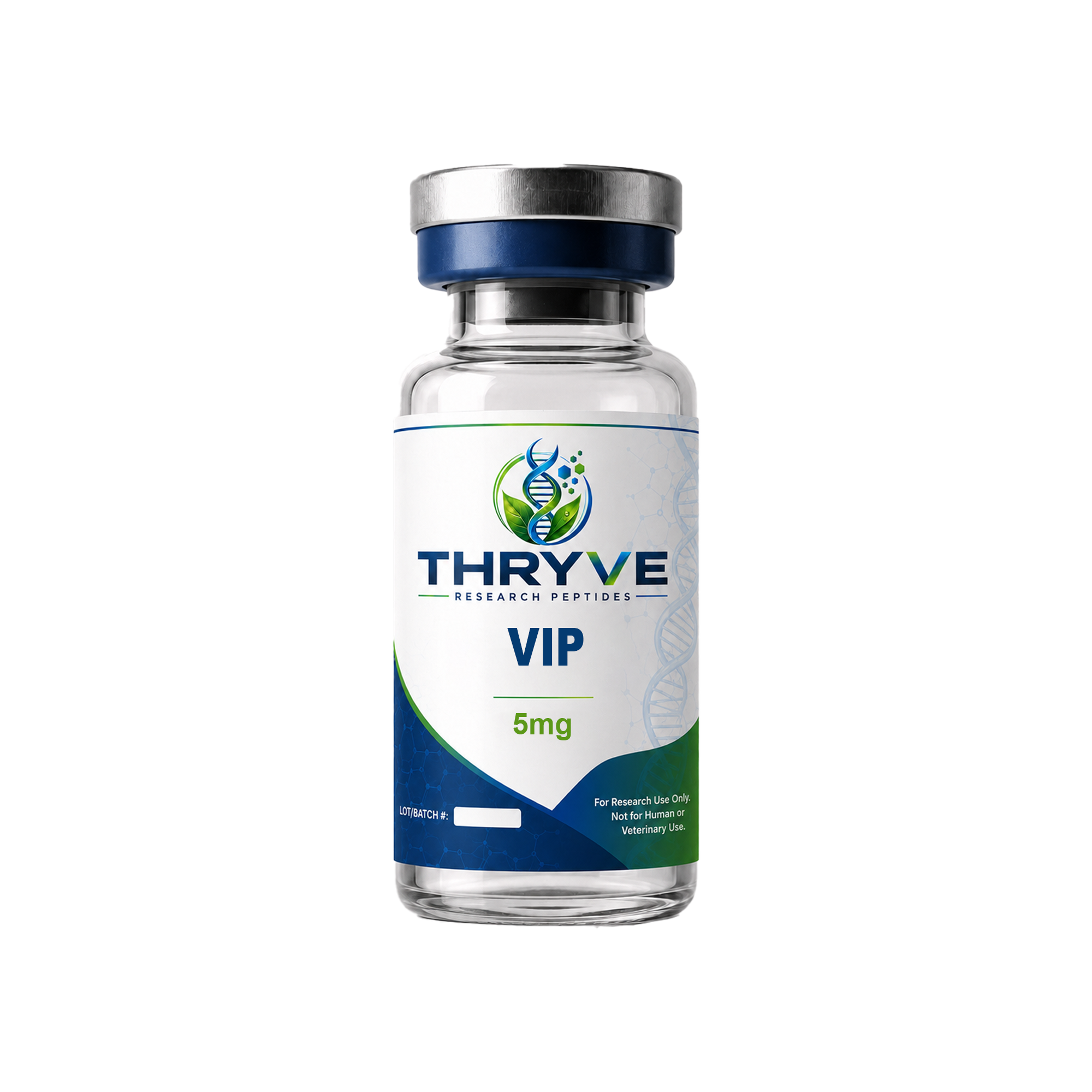
Researchers should confirm the exact chemical form and stated quantity against the product label and available lot-specific documentation before relying on reference specifications.
PRODUCT SPECIFICATIONS
| Specification | Details |
| Product Name | VIP |
| Full Name | Vasoactive Intestinal Peptide |
| Compound Classification | Neuropeptide |
| Peptide Length | 28 amino acids |
| Molecular Formula | C₁₄₇H₂₃₇N₄₃O₄₃S |
| Molecular Weight | Approximately 3,326.8 g/mol |
| CAS Number | 37221-79-7 |
| Reference Sequence | HSDAVFTDNYTRLRKQMAVKKYLNSILN |
| Laboratory Documentation | Applicable lot-specific records, where available |
| Intended Context | Laboratory and analytical research |
The specifications above refer to the reference VIP peptide. Confirm sequence, chemical form, and any salt or counterion details against the supplied material’s documentation. <Cite refs={[“turn242649search4″,”turn242649search7”]} />
SCIENTIFIC BACKGROUND
VIP is a linear peptide consisting of 28 amino acid residues. Its sequence and molecular characteristics are established reference points for peptide identification and analytical comparison.
Research involving VIP includes examination of peptide-receptor interactions and intracellular signaling mechanisms. These scientific topics provide context for studying the compound’s molecular properties without implying that a commercial research material is suitable for clinical or therapeutic use.
RESEARCH APPLICATIONS
Potential laboratory-focused areas of investigation include:
· Peptide Identification: Comparing analytical findings with established sequence and molecular reference data.
· Molecular Characterization: Examining chemical composition and structural properties.
· Receptor Interaction Research: Studying peptide-receptor interactions in controlled experimental systems.
· Analytical Method Development: Evaluating suitable methods for peptide characterization.
· Stability Research: Investigating material stability under controlled laboratory conditions.
· Batch Documentation Review: Comparing product labeling with available analytical records.
These applications describe scientific research contexts only and do not establish clinical efficacy, safety, or suitability for human or veterinary use.
QUALITY & LABORATORY DOCUMENTATION
Products are supported by applicable third-party laboratory testing documentation. Independent verification and additional testing may be conducted where appropriate.
Where available, researchers should review lot-specific documentation for:
· Compound identity and stated chemical form
· Reported analytical results and testing methods
· Batch or lot identification
· Testing date and laboratory information
· Any stated limitations or qualifications
Documentation availability and scope may vary by product and lot. General molecular reference data should not be treated as independent confirmation of a particular batch’s identity or purity.
LOT & BATCH REFERENCE
The product label and corresponding batch documentation should be used to confirm the stated quantity, peptide identity, and applicable analytical records. Researchers should ensure that documentation corresponds to the specific lot being evaluated.
STORAGE & HANDLING
Follow the storage and handling requirements provided in the product-specific documentation. Maintain appropriate laboratory labeling, secure storage, and handling procedures in accordance with applicable institutional requirements.
RESEARCH USE STATEMENT
This material is intended strictly for lawful laboratory and analytical research. It is not intended for human or veterinary use, consumption, self-administration, diagnosis, treatment, cure, or prevention of any disease.
IMPORTANT NOTICE
Product descriptions and chemical reference information are provided for informational purposes only. Confirm the supplied material’s identity, chemical form, and applicable batch documentation before relying on product-specific technical details. This listing does not constitute medical advice or a representation of clinical safety or effectiveness.
Reviews
There are no reviews yet.